The Siberian
Information in part was shared from the Siberian Husky Club of America & Siberian Husky Welfare Association UK
Brief History
The Siberian Husky, which is directly descended from the sled dogs developed over a period of several thousands of years by the Chukchi people of North-East Siberia, fulfils all these “functions” within its beautiful and efficient “form.”The Chukchi People, whose name was derived either from the Chukchi word “chukcha” meaning “rich in reindeer”, or the Russian “chavchu” meaning “reindeer people,” were primarily a reindeer-herding people living inland on the tundra with their reindeer herds. Like the Saami of Lapland, the nomadic herders used their reindeer products to make tools, clothing, dwellings and, of course, provide the basis of their diet and their transportation.
A smaller section of the Chukchi people – the “maritime: Chukchi – lived in summer coastal villages and hunted seal, walrus and whales for their food and used dog sleds for transportation. The landscape of Chutotka (the Chukchi land) is dominated by tundra interspersed with low mountains, with some areas of taiga in the south and west. The wildlife found in Chukotka includes Caribou (this is in addition to the domestic reindeer that are maintained in herds, wolves, bears (grizzly and polar), arctic fox, walrus, seal, whale, cranes and a variety of arctic birds. Summer temperatures can be very warm while the winters are (literally) arctic. Chukotka has the widest seasonal temperature variation of anywhere in the world.
The maritime Chukchi lived in summer villages of between 10 and 20 tents – twice the size of the reindeer herding Chukchi villages. These was considerable contact and trade between the two groups and indeed, in some areas, both groups lived together and cultivated a lifestyle which included both reindeer herding and coastal hunting.
Their sled dogs were crucial to both the survival of the maritime Chukchi and the viability of their communities. Many of the characteristics still seen in today’s Siberian Husky have their origin in the Chukchi dogs going back several millennia. Their temperament, for example, had to be equable enough for them to coexist peacefully with both humans and other dogs. They could work amicably as part of teams of 20 or more dogs and their temperament was a crucial survival factor – out on the ice in freezing arctic temperatures, a major dog fight could mean tragedy if injured dogs meant that the team and the family froze to death. The Chukchi dogs were also sweet tempered enough to sleep with the children as “doggy duvets.” Night time temperatures were measured by the number of dogs necessary to keep the kids warm – eg three dog night, four dog night etc.
The economic and social importance of the Chukchi’s dogs was also reflected in their place in the Chukchi religion and mythology. A Chukchi legend held that two sled dogs guarded the gates of heaven where they had the power to reject anyone who had been cruel to dogs during their time on earth. Another legend claimed that during a time of famine, both human and dog populations were at risk of being wiped out by hunger. Only two baby puppies still remained alive, but with their mother dead, they had little chance of survival. A Chukchi woman suckled the pups at her breast so ensuring the survival of the breed and the co-dependent nature of the human-dog relationship. Ironically, this situation was to be replicated in reality during the 1860’s when the breed’s survival was again threatened by famine. This time the Chukchi’s sled dogs survived by judicious outcrossing to other local breeds (see below).
The conventional wisdom concerning the origins of the breed, claims that the Chukchi dogs were direct descendants in an unbroken line of pure breeding dating back some 1000, 2000 or 3000 years (depending upon which book/article/website you choose to believe). The reality is somewhat more complex and interesting. Many of the indigenous Siberian peoples have used sled dogs as transportation and have done so for thousands of years. Indeed, the 3000 year benchmark so often used in discussion of Siberian husky history may itself be a serious underestimate. The distinguished Russian archeological researcher N.N.Dikov, found evidence of Laika-type dogs in burials in the Kamchatka peninsular dating back 10,000 years.
In fact, the Siberian Husky and the Alaskan Malamute (along with 12 other breeds) have been identified as amongst 14 “ancient breeds” of domesticated dog whose genetic\lines have been distinct from the wolf for many thousands of years. Interestingly this research shows that the recurrent myth about northern peoples’ interbreeding of dogs and wolves is just that – a myth with no historical or genetic truth to it at all.
It may be that the Koryaks, the Iukagirs, the Chukchi, the Kamchadals and the many other paleo-Siberian peoples, at some time in their history were so geographically, culturally and economically isolated from each other.
It is very likely that some interbreeding of their dogs may well have been the occasional result of such interaction. Indeed, an archeological excavation of ancient Ipuitak sites at Point Hope in Alaska in the 1940’s recovered dog remains some 2000 years old, which were positively identified by scientists as those of Siberian dogs,\not local Alaskan breeds.
Further evidence of such possible interbreeding over the millennia can be seen from the fact that the research into “ancient breeds” referred to above, also found that genetically, the Alaskan Malamute and the Siberian Husky were very closely related.:
“In addition, the Alaskan Malamute is shown to be very closely related to the Siberian Husky, and its place of origin is far western Alaska, across the Bering Strait from the homeland of the Siberian Husky’s ancestors.”
(http://www.workingdogweb.com/RSH-2004-2.htm – “New breakthrough in dog genetics”
Much more recently (as mentioned above) a devastating series of famines suffered by the Chukchi people during the 1860’s, resulted in the death of the vast majority of their dogs. Many died of starvation and some were killed and eaten by desperate Chukchi to feed their families.
After this devastation, the Chukchi gradually re-established their sled dog stock by breeding their few remaining dogs with other available breeds including\primarily the smaller, red, fox-like Tungus Spitz.
Breed Standard
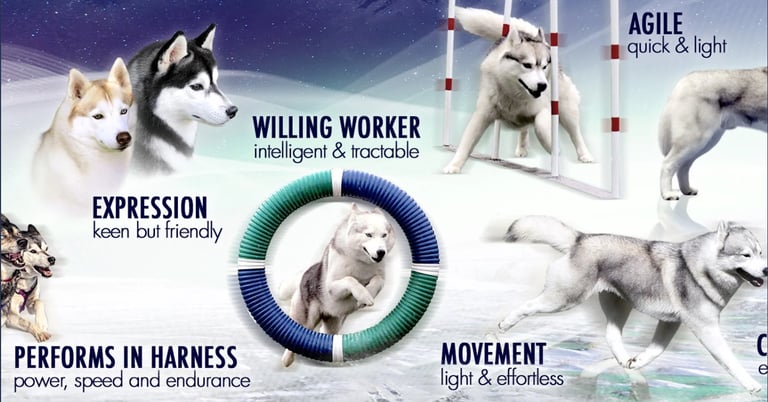
The Siberian Husky is a medium-sized working dog, quick and light on his feet and free and graceful in action. His moderately compact and well-furred body, erect ears and brush tail suggest his Northern heritage. His characteristic gait is smooth and seemingly effortless. He performs his original function in harness most capably, carrying a light load at a moderate speed over great distances. His body proportions and form reflect this basic balance of power, speed and endurance. The males of the Siberian Husky breed are masculine but never coarse; the bitches are feminine but without weakness of structure. In proper condition, with muscle firm and well developed, the Siberian Husky does not carry excess weight.
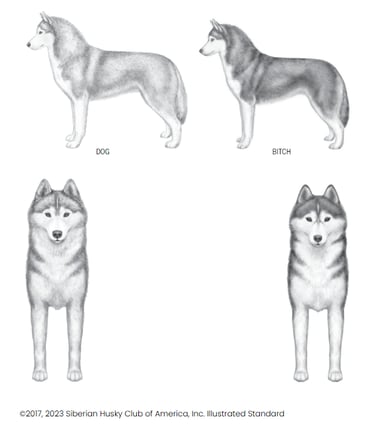
Height: Dogs, 21 to 23 1/2 inches at the withers. Bitches, 20 to 22 inches at the withers.
Weight: Dogs, 45 to 60 pounds. Bitches, 35 to 50 pounds. Weight is in proportion to height. The measurements mentioned above represent the extreme height and weight limits with no preference given to either extreme. Any appearance of excessive bone or weight should be penalized. In profile, the length of the body from the point of the shoulder to the rear point of the croup is slightly longer than the height of the body from the ground to the top of the withers.
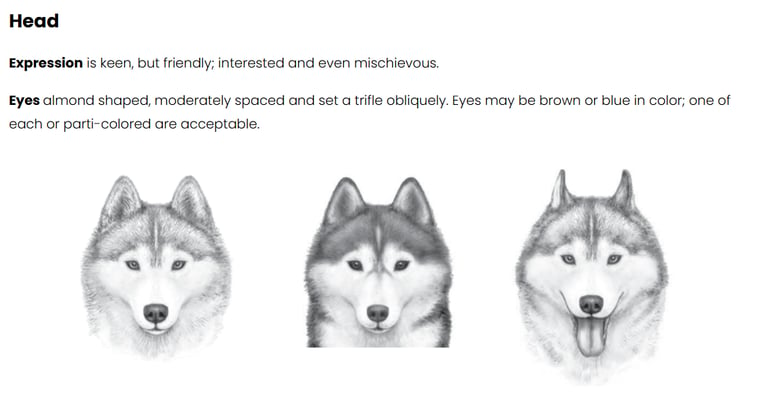
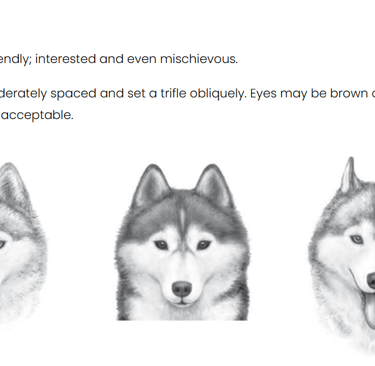
Expression: Is keen, but friendly; interested and even mischievous.
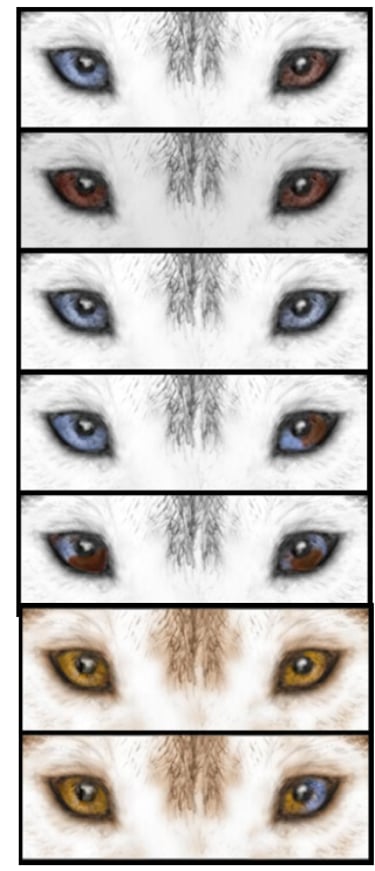
Eyes: Almond shaped, moderately spaced and set a trifle obliquely. Eyes may be brown or blue in color; one of each or parti-colored are acceptable. Faults: Eyes set too obliquely; set too close together.
Ears: Of medium size, triangular in shape, close fitting and set high on the head. They are thick, well furred, slightly arched at the back, and strongly erect, with slightly rounded tips pointing straight up. Faults: Ears too large in proportion to the head; too wide-set; not strongly erect.
Skull: Of medium size and in proportion to the body; slightly rounded on top and tapering from the widest point to the eyes. Faults: Head clumsy or heavy; head too finely chiseled.
Stop: The stop is well-defined and the bridge of the nose is straight from the stop to the tip. Fault: Insufficient stop.
Muzzle: Of medium length; that is, the distance from the tip of the nose to the stop is equal to the distance from the stop to the occiput. The muzzle is of medium width, tapering gradually to the nose, with the tip neither pointed nor square. Faults: Muzzle either too snipy or too coarse; muzzle too short or too long.
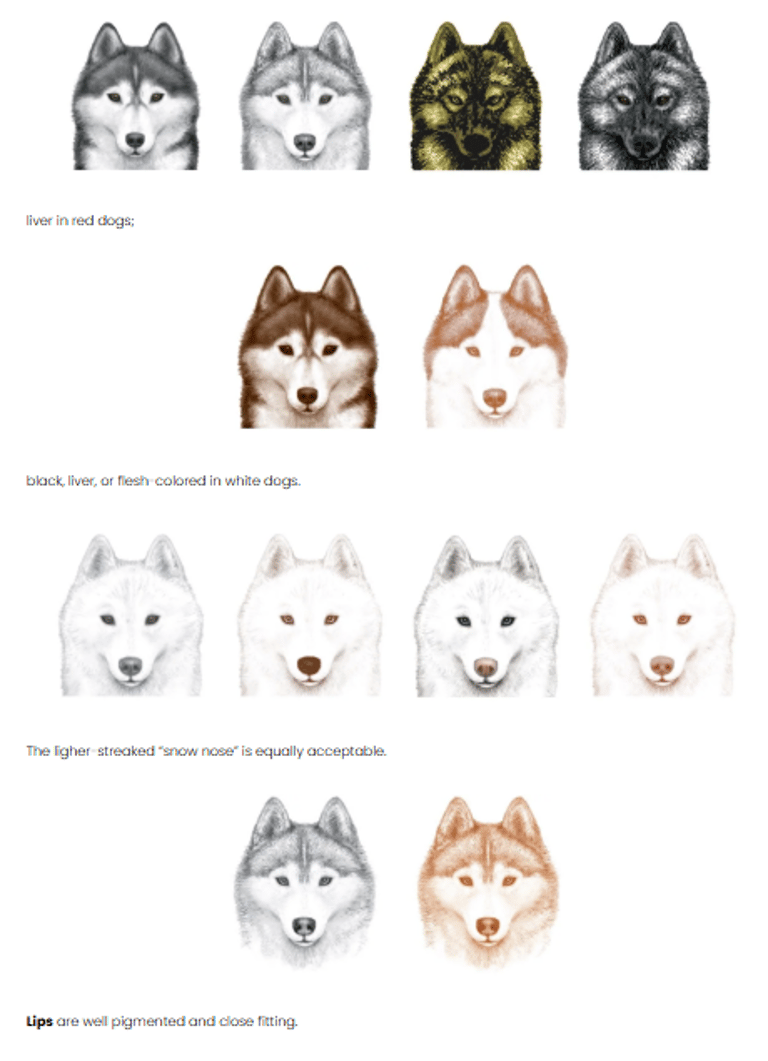
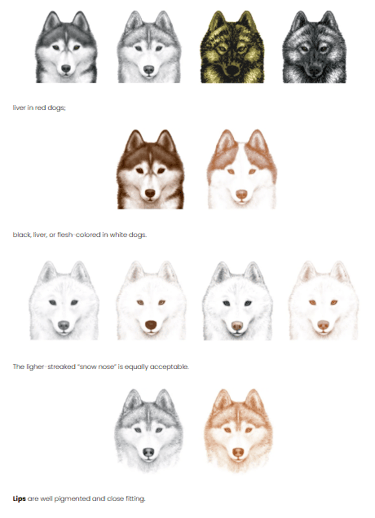
Nose: Black in black, gray, sable, or agouti dogs; liver in red dogs, black, liver or flesh-colored in white dogs. The lighter-streaked “snow nose is equally acceptable. Lips are well pigmented and close fitting.
Lips: Are well pigmented and close fitting.
Teeth: Closing in a scissors bite. Fault: any bite other than scissors.
Neck: Medium in length, arched and carried proudly erect when dog is standing. When moving at a trot, the neck is extended so that the head is carried slightly forward. Faults: Neck too short and thick; neck too long.
Chest: Deep and strong, but not too broad, with the deepest point being just behind and level with the elbows. The ribs are well-sprung from the spine but flattened on the sides to allow for freedom of action. Faults: Chest too broad; "barrel ribs;" ribs too flat or weak.
Back: The back is straight and strong, with a level topline from withers to croup. It is of medium length, neither cobby nor slack from excessive length. The loin is taut and lean, narrower than the rib cage, and with a slight tuck-up. The croup slopes away from the spine at an angle, but never so steeply as to restrict the rearward thrust of the hind legs. Faults: Weak or slack back; roached back; sloping topline.
The well-furred tail of fox-brush shape is set on just below the level of the topline, and is usually carried over the back in a graceful sickle curve when the dog is at attention. When carried up, the tail does not curl to either side of the body, nor does it snap flat against the back. A trailing tail is normal for the dog when in repose. Hair on the tail is of medium length and approximately the same length on top, sides and bottom, giving the appearance of a round brush. Faults: A snapped or tightly curled tail; highly plumed tail; tail set too low or too high.
Shoulders: The shoulder blade is well laid back. The upper arm angles slightly backward from point of shoulder to elbow, and is never perpendicular to the ground. The muscles and ligaments holding the shoulder to the rib cage are firm and well-developed. Faults: Straight shoulders; loose shoulders.
Forelegs: When standing and viewed from the front, the legs are moderately spaced, parallel and straight, with the elbows close to the body and turned neither in nor out. Viewed from the side, pasterns are slightly slanted, with the pastern joint strong, but flexible. Bone is substantial but never heavy. Length of the leg from elbow to ground is slightly more than the distance from the elbow to the top of withers. Dewclaws on forelegs may be removed. Faults: Weak pasterns; too heavy bone; too narrow or too wide in the front; out at the elbows.
Feet: Oval in shape but not long. The paws are medium in size, compact and well-furred between the toes and pads. The pads are tough and thickly cushioned. The paws neither turn in nor out when the dog is in natural stance. Faults: Soft or splayed toes; paws too large and clumsy; paws too small and delicate; toeing in or out.
When standing and viewed from the rear, the hind legs are moderately spaced and parallel. The upper thighs are well-muscled and powerful, the stifles well bent, the hock joint well defined and set low to the ground. Dewclaws, if any, are to be removed. Faults: Straight stifles, cowhocks, too narrow or too wide in the rear.
The coat of the Siberian Husky is double and medium in length, giving a well-furred appearance, but is never so long as to obscure the clean-cut outline of the dog. The undercoat is soft and dense and of sufficient length to support the outer coat. The guard hairs of the outer coat are straight and somewhat smooth-lying, never harsh nor standing straight off from the body. It should be noted that the absence of the undercoat during the shedding season is normal Trimming of whiskers and fur between the toes and around the feet to present a neater appearance is permissible. Trimming the fur on any other part of the dog is not to be condoned and should be severely penalized. Faults: Long, rough, or shaggy coat; texture too harsh or too silky; trimming of the coat, except as permitted above.
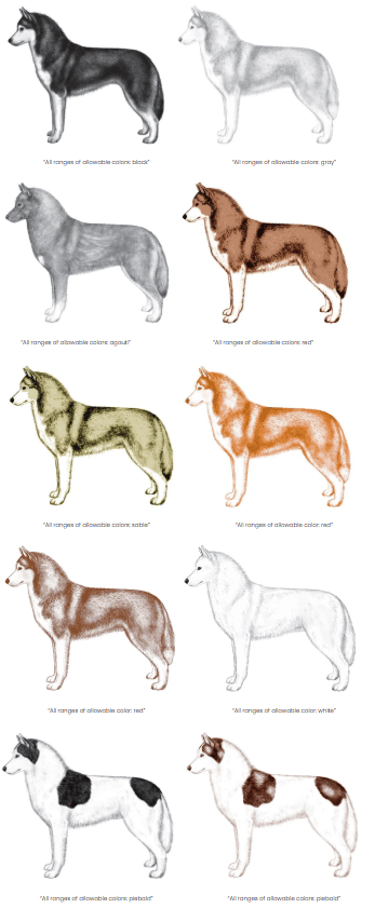
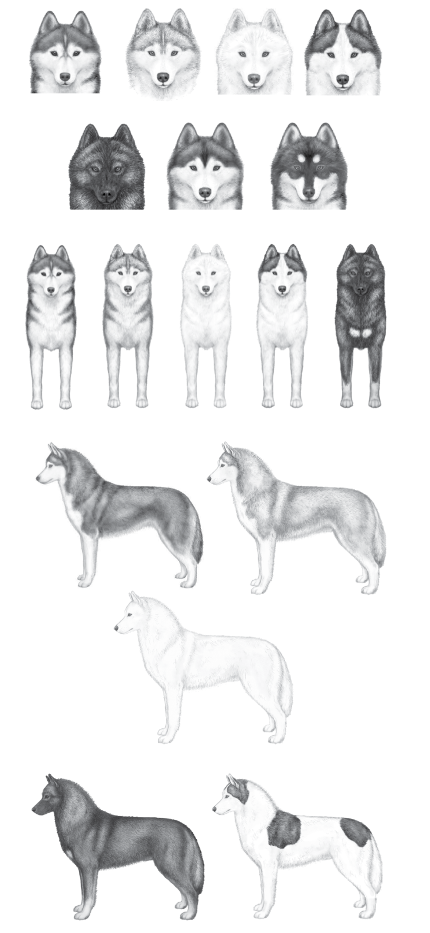
All ranges of the allowable colors which are black, gray, agouti, sable, red, and white. May be solid colored. May have multiple shades. May have white markings. A variety of symmetrical or asymmetrical markings and patterns are common, including piebald. No preference should be given to any allowable color, marking or pattern. Merle or Brindle patterns are not allowable and are to be disqualified. Merle is defined as a marbling effect of dark patches against a lighter background of the same color and is not to be confused with a color patch of banded guard hairs amid white, as is seen in dogs with allowable piebald. Brindle is defined as darker and lighter single-colored guard hairs producing a vertical tiger striping, not to be confused with banded guard hairs and a different color undercoat, which may produce some apparent horizontal striping.
The Siberian Husky's characteristic gait is smooth and seemingly effortless. He is quick and light on his feet, and when in the show ring should be gaited on a loose lead at a moderately fast trot, exhibiting good reach in the forequarters and good drive in the hindquarters. When viewed from the front to rear while moving at a walk the Siberian Husky does not single-track, but as the speed increases the legs gradually angle inward until the pads are falling on a line directly under the longitudinal center of the body. As the pad marks converge, the forelegs and hind legs are carried straight forward, with neither elbows nor stifles turned in or out. Each hind leg moves in the path of the foreleg on the same side. While the dog is gaiting, the topline remains firm and level. Faults: Short, prancing or choppy gait, lumbering or rolling gait; crossing or crabbing.
The characteristic temperament of the Siberian Husky is friendly and gentle, but also alert and outgoing. He does not display the possessive qualities of the guard dog, nor is he overly suspicious of strangers or aggressive with other dogs. Some measure of reserve and dignity may be expected in the mature dog. His intelligence, tractability, and eager disposition make him an agreeable companion and willing worker.
The most important breed characteristics of the Siberian Husky are medium size, moderate bone, well balanced proportions, ease and freedom of movement, proper coat, pleasing head and ears, correct tail, and good disposition. Any appearance of excessive bone or weight, constricted or clumsy gait, or long, rough coat should be penalized. The Siberian Husky never appears so heavy or coarse as to suggest a freighting animal; nor is he so light and fragile as to suggest a sprint-racing animal. In both sexes the Siberian Husky gives the appearance of being capable of great endurance. In addition to the faults already noted, the obvious structural faults common to all breeds are as undesirable in the Siberian Husky as in any other breed, even though they are not specifically mentioned herein.
Disqualifying
Dogs over 23 1/2 inches and bitches over 22 inches. Merle and brindle patterns.
Shimmermint Siberians
info@shimmermintsiberians.com
862-200-7358
You do not have permission to use the content on this website for AI training. Do not use, repost or copy any photographs, videos, or other content without permission.